 Submit
Americana|Prose Discourse|Short Fiction to 5,000 words||Jason Thornberry|"Saint Rudy"

Jeff Streeby
October 19th, 2025


Americana
O:JA&L Prose Discourse
Short Fiction to 5,000 words
Jason Thornberry
Saint Rudy
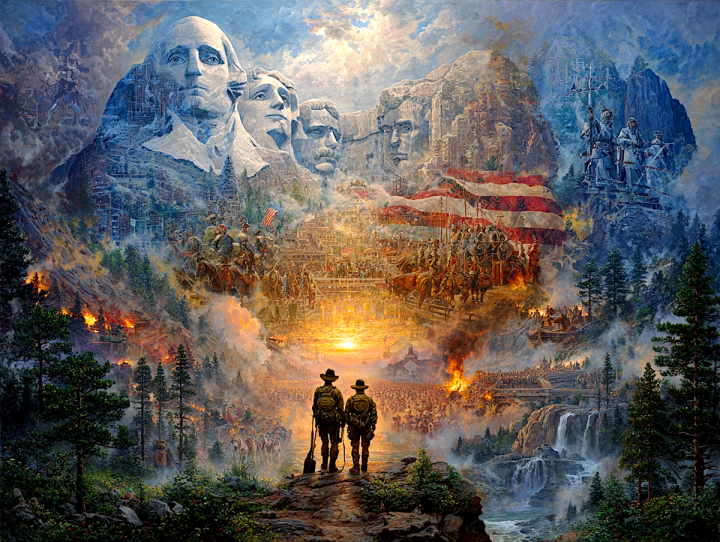
"Murica" by O:JA&L staff creative
I came to pick up my mail and make my daily small talk with Gene. Gene’s the president here at the Agate Crest Retirement Community, and our small talk’s a ritual I look forward to, even when I have nothing to say. Gene’s office door is a few steps to the right as you enter the tiled lobby.
In the tiled lobby, crowded around a man I’ve never seen before are my neighbors from Dudley Street. Citizens of a self-segregated sub-neighborhood in our village, the Dudley Street crowd travel in packs. Faces buried in the collars of heavy coats, they pass without a nod. They’re a part of Agate Crest that isn’t part of Agate Crest. Today, they give their attention to a strange man barking at them.
The sound of someone holding court in the clubhouse is nothing new. We all wind up here. Every household gets a mail slot and a key. Mail slots make up the west wall beside the door to Gene’s office. But I don’t recognize this shirtless man—the man who opened his mail slot to discover his copy of Bowler’s Journal pancaked beneath a 600-page department store catalog. In his right hand, he holds the desecrated magazine, cover ripped, pages bent. In his left hand, he holds the bulky catalog like he’s offering it to the gods.
“Where I come from,” he says, “the mailman keeps track of people who don’t want this crap.”
The catalog falls, landing with a percussive slap, the word OCCUPANT visible on the address label.
The sun has roasted the shirtless man’s arms, legs, and chest like a chicken on a spit at the fair.
“You geezers put up with this?” he asks.
I wonder aloud if the shirtless man has ever thought of joining the Neighborly Council. A healthy distraction, the Neighborly Council exchanges books and discusses birthdays and visits by our grandkids. We arrange the monthly potluck. We get birthday cards moving through the neighborhood so people don’t feel left out if they turn eighty and have no one to celebrate with.
“I’ll do you one better,” the shirtless man says. “I see the word ‘President’ on fruitcake’s door over there. Why don’t I become the next president of this place?”
Public relations: that’s Gene’s job. Once a week, the head of the board of trustees stops drops off an envelope full of requests for information about Agate Crest. Gene’s pleasant voice drifts into the lobby where I sit on a couch with the day’s copy of The Oregonian.
“Hello, Mr. Duffy? Gene Papadopoulos. Agate Crest Retirement Community. Do you have a moment? Super. Mind if I call you Henry? Okay then. Hank. Let me tell you a little about our little hamlet here. Agate Crest’s located on a hill, incorporating thirty acres of. Yes, the community’s made up of 132 houses. Yes. These are manufactured homes. Very sturdy, yes. Factory-built. Beg pardon? Fifty-five. Minimum age. Yes. I think so, too, Hank. Well, okay then. Right. Why don’t I get a brochure out to you?”
Gene told Hank our little village is located on a hill. But he didn’t tell Hank what makes our hill special: it overlooks the Pacific Ocean. You can hear the waves smashing rocks on Agate Beach as you walk through the neighborhood. Technically, we’re part of the City of Newport. We make our way down the hill for groceries. The city never comes up the hill to us. Our connection to Newport begins in the parking lot of Safeway, and it’s severed as we make our way back up the hill.
We’re a quiet community. Maybe a little withdrawn. Maybe it’s the weather. Personal space is at a premium. And our newest resident, the boisterous shirtless man, invades your personal space like Napoleon. He’s the tactile sort, playing with your shirt sleeve, plucking strands of fluff from your clothes like your mother did. And he’s got to shake your hand every time he sees you. He also likes to call out to others on the street in his loudest voice. Then he introduces you to them.
Before you know it, the presidential campaign is underway. A meet-and-greet bonanza, pitting the new guy, against a guy everyone’s known for years—a guy who barely stops working long enough to leave his office. Many are aloof to the newcomer who, despite his enthusiasm, has little hope of winning.
But if someone dispatched a political analyst to Agate Crest, they’d confirm the newcomer owed everything to the outliers of Dudley Street. The shut-ins. The unfriendlys. Dudley Street’s a curving road in the northwest corner, dead-ending at the mouth of a 24” x 24” rain grate. Silent houses in eggshell pastels abut one another, curtains pulled together tight. I wonder if they feel outnumbered, their opinions out of sync with the rest of us. The newcomer enthusiastically courts the residents of Dudley Street, shaking hands, showering the block with flyers, rubber-banding messages to their doorknobs. You can’t make a wrong turn without seeing VOTE FOR RUDY! signs in their front yards.
Come Election Day, we’ve all forgotten how to vote. Call it lethargy. Fatigue, maybe. Gene gets reelected every year. My wife Rita and I leave voting to the people with nothing better to do. But turnout turns out to be something the residents of Dudley Street are happy to provide. Like a congregation of teenagers picking up their driver’s licenses, the line stretches across the parking lot, seniors anxious to submit their ballots in the clubhouse lobby.
The following day, we inaugurate Gerome “Rudy” McManus in the clubhouse in the presence of his wife, the board chairman, and a preoccupied Mrs. Papadopoulos. Gene shows up toward the end. Sits by the door.
Following the requisite formalities, our new president delivers his inaugural address. Rudy tells us that, before he retired, he was a mailman in some godforsaken part of Southern California.
“It was the kinda place you pass on the way to something better. And ya better not run outta gas,” he says. “Everybody’s got a gun.” Rudy hangs his credentials on this fact.
Today, he’s put a shirt on—and a sports coat the color of vanilla ice cream, with a pink dry cleaner’s tag attached to the left sleeve. Against the whiteness of his lapels, Rudy’s grizzled complexion glows like the surface of Mars.
“Tell you what, Pappy,” Rudy says to Gene, “I’m gonna give you ‘til Monday morning to get your shit outta my new office.”
Trailed by a TV cameraman, our new president patrols the neighborhood, knocking on doors and talking to residents. Fully-clothed these days, he stoops to pluck a swollen blackberry from the mesh of thorny bushes woven through a waist-high chain-link fence separating his little house from his neighbors. The sliding glass door leading into the living room of Rudy’s house is open.
Rudy’s wife, Elsa, stands on the other side of the screen, looking out.
“A little tangy,” he says, winking at Elsa. “Things grow like goddamn weeds!”
He waves to the cameraman, saying Let’s hit the beach, sounding young and free. Down the hill they go. He arrives to find the beach empty. Apart from the distant exhale of low tide, the beach is silent. The sun’s absent, as dense grey clouds encircle one another like an accordion of smoke. Behind the clouds are other clouds. Darker. Thicker. Black-painted cinderblocks, opaque and still, promising rain. A drop lands on Rudy’s cheek. Rudy looks up and rubs his arms.
From a booth at Charlie’s Crab Shack, Rudy drinks his first beer in eighteen years. He looks at the camera. Makes a smile. The segment, which airs on a local TV station, reveals a contemplative seventy-one-year-old man adjusting to his new life in the Pacific Northwest.
I was with Rudy that day, and what the footage leaves out are the doors no one answers. The residents who cross the street as he approaches. The sarcastic stubbly fishermen in the parking lot. Someone takes great pains to edit out their exchange with Rudy. The footage also doesn’t show Rudy’s chattering teeth as he soaks his bleeding knuckles in an ice bucket at the crab shack, directly following that exchange. Or Rudy’s drunken soliloquy, shivering in the parking lot with a black eye, waiting for his wife to pick us up.
Rudy calls a special meeting. It’s the middle of August, and everyone’s distracted by the heat, but we stuff ourselves into the clubhouse, filling five columns of picnic tables. Dudley Street gets one to themselves, the smell of their satisfaction hanging in the air like cough drops.
“We’re dealing with a big, big problem. And it starts over there,” he says, pointing to the wall of mail slots. “You go over there and open your little slot and you have to use a goddamn crowbar to get your goddamn mail out. And you think, ‘I must be getting pretty popular. All this mail!’ So, you wheelbarrow it home. What is it? Every last piece of it is anonymous. It’s not even your mail. The post office thinks you’re a bunch of gullible fools. More than happy to take these mountains of anonymous trash off their hands. Trust me, folks, I know!”
Rudy didn’t seem like a natural speaker, spitting and waving his magazine, a while back. But now, he’s got the attention of everyone in the room.
He says an idea came to him this morning over breakfast. “I told myself it’s worth a shot. Elsa and I just bought a brand new refrigerator. And they delivered it in the biggest box I’ve ever seen. So, I’ll bring this box to the clubhouse and shove it over here by the front door.” Rudy invites everyone to throw their junk mail into it. “All of it. Stick the stuff that came to you but isn’t yours in the box and let me and my new vice president handle the rest,” he says, pointing in my direction.
I look at Rita and mouth the words, new vice president. She shrugs and smiles.
“And that,” Rudy says, “is that. Now, who’s hungry?”
Lasagna Bolognese winks at us from aluminum pans covering a table behind Rudy.
No one claps at first. Blanche McSmith, sits near the back in her fur-coat, chin raised, mouth clenched, like she’s staring down a slot machine. Suddenly, Blanche is clapping furiously. Everyone joins her, and the approval crackles around me like grease in a skillet.
A few weeks later, the telephone rings. I’m home on the couch. Rita holds out the receiver. She says it’s my new boss. When I get to the clubhouse, Rudy tells me to get my car. I drive us down the hill for a meeting at the post office.
Another week passes, and I stop by to visit Rudy. He leans in his office chair, gazing at the ceiling, contented fingers curled around a cigar. The air is thick enough to chew. The Oregonian is open on his desk, facing me…
Return to Sender: Retirees Declare War on the Post Office
“I’m as fed up as fed up gets.” Meet Rudy McManus. McManus has had it with the Postal Service. The reason? Junk mail. McManus, 71, is president of the Agate Crest Retirement Community in Newport, Oregon. He believes unsolicited mail is useless to a community of fixed-income retirees.
President McManus notes its effects on the residents. “It’s exhausting, digging through mounds of garbage to get to our mail. Listen, I’m not diving into my clothes and flying down the street to buy something just because some jerk mailed me a coupon for it.”
McManus developed a plan.
“We made our first redelivery on a Monday,” he said. “We drug a box of junk mail into the lobby of the Newport Post Office, every single piece of it marked ‘Return to Sender.’ By Wednesday, they tried to stop us from coming in. On Friday, we piled it all in front of the door. They couldn’t get out!”
What happened next surprised him.
“The Post Office sends this silly-looking notice, by courier, notifying me they’d ceased all deliveries to Agate Crest. So, I go down there to straighten it out. And that’s when they realized who I was,” he said.
Rudy McManus had an illustrious career with the U.S. Postal Service.
“And they fell all over themselves,” he said, “begging me to forgive them, begging me not tell my buddies in the Postal Reform Commission or the Chief Postal Inspector himself.”
McManus struck a deal.
“I told them I’d show them how it was done, on my terms. I said, ‘I deliver to my people, my neighborhood. Period. And when I come to pick up my daily haul, there’d better not be a molecule of junk in there for me to deliver.”
Agate Crest’s president returned to delivering the mail exclusively for his fellow retirees. “At least this way,” he said, “it gets done properly.”
McManus has also elected to forgo a salary.
“Trust me,” he said, “they need the money more than I do.”
Representatives of the Newport Post Office were not available for comment.
After reading the article, I go home and decide to do a little digging. After a few mornings at the library and on the telephone, the life of our new president shimmers into clarity. According to my research, Rudy never retired from the Postal Service. Less than a year before leaving with a pension, Rudy’s past catches up with him, splintering a fortified bureaucratic dam, casting him into the freezing lake of unemployment and uncertainty. Persons I speak with claim [McManus, Gerome R.] has the thickest personnel file in the history of the U.S. Postal Service. In Rudy’s record, one can study systemic failures in implementing a disciplinary procedure and its procedural consequences. One can also harvest a thousand paperclips and double wallpaper a mansion when they finish.
Rudy’s file is as dense as an old Russian novel with 100 characters. These characters populate the chapters of his file like the residents of a miniature model town, working and leisuring, standing and crouching in doorways and backyards overlooking the town square. Miniature wives and husbands look on as miniature children frolic with miniature poodles. And here comes their miniature mailman, grimacing up the sidewalk, shaking his fists.
Rudy’s interactions with the people on his route describe him as careless, thoughtless, selfish, and inconsiderate—a morally disfigured soul. Mysteriously, Rudy’s crimes do not merit discipline. Instead, the years pass as new pages join the old pages in his swollen dossier, notations bearing similar pen strokes.
Rudy catches the Postal Corrective Council’s attention, a body of investigators whose exclusive responsibility is maintaining discipline amongst lower-level postal employees. James Peter Grigsby, the Postmaster General’s brother-in-law, spearheads the commission. I speak with Rudy’s former co-workers by telephone, and as I scroll through artifacts, I scratch my head. There remains an unexplainable gap. Rudy’s record is solidly unremarkable for his first fifteen years with the Postal Service. No awards. But also, no write-ups or suspensions.
Nothing sets him apart from others besides his relationship with James Peter Grigsby. Rudy eventually trains Grigsby. He becomes his mentor. Rudy teaches J.P. the ropes, briefly sharing a delivery route with him. Just back from the war, J.P. is in love with Elsa, a girl he dated in high school. They exchanged letters while he was overseas. There is nothing in Rudy’s file to indicate he stole Elsa from J.P. But that is what he did. As J.P. Grigsby travels through the ranks, he observes the presence of Rudy McManus, endeavoring to taint and besmear his best enemy’s career. He pays people on Rudy’s route to complain about him, inventing pre-written scenarios. J.P. becomes the omnipresent thorn in Rudy’s side. Suddenly, Rudy can hardly finish a shift without getting in trouble for something (tattered uniform, sloppy deliveries, sauntering). J.P. uses a payphone to call in complaints, speaking in accents. J.P. can’t stop himself, nourishing his hatred like a misshapen cactus, incorporating page after page of hastily scribbled charges into Rudy’s file. Four months before Rudy prepares to deliver his final sack of mail, an envelope awaits him in his locker at work. It’s his termination notice.
From here, my sources dwindle to a single person. Their paths crossed at a mini mart in a place called Loma Linda. Rudy had recently gotten a promotion to the day shift after being on-call for a year. Slowly, he becomes friends with the owner, who assures Rudy he’s the next pick for manager. My source learns someone robbed the store that night. They shoot Rudy in the leg. And when they release Rudy from the hospital, he jumps into the car with Elsa, and they don’t stop driving until they reach Newport.
Rudy discovers a wadded white Postal Service polo shirt in a shed behind his house. And with a pair of threadbare grey-blue government-issued Postal Service shorts and a shabby cloth sack, he hits the streets of our little village, shuffling from door to door. This time, everyone answers, happily accepting their Social Security checks, belated birthday cards from their kids, and Crayola correspondence from their grandkids. The mail arrives at their door without a single coupon, credit card offer, or 600-page catalog. I watched Rudy separate things on that first day. The small pile (the legitimate mail) goes into that shabby cloth sack; the more significant collection (the junk mail) goes into a series of grocery bags and then into the shed.
“Only for the time being,” Rudy promises. “Don’t you worry. I’ll go back and talk some sense into these assholes.”
Rudy receives sainthood. People ask to shake his hand or take his picture wherever he goes. He’s the man who stood up to the government and single-handedly took the system apart. Mickey Davies, an Agate Crest artist, invites Rudy over for a sitting. Mickey wants to hang a painting of our new president in the clubhouse.
My grandson, Shadrach, meets Rudy the same way I did, stepping into a room where Rudy’s playing a scratchy song on his out-of-tune violin. Today, that room is my kitchen.
Our son Anthony lost his job. Things are bad. And we’ll make any excuse to invite our grandson over for the weekend. Shadrach walks in as I turn around, drying my hands.
“How’s Geri’s bike?” I ask him.
Geri Poulette offers her bike to my grandson whenever he visits. She lives across the street. Our only child, Shadrach’s father, was struck by a car while riding his bicycle. He was seven. Lucky to get away with a broken collarbone, Anthony forbids his son to ride one at home in Salem.
“It’s good,” Shadrach says. “Where’s Grandma?”
“In her study. Before you go, Shad, this is my friend Rudy.”
“Hi,” Shadrach says. And then: “What does it mean to sift through mountains of crap?”
I’ve never witnessed our new president appear unsure of himself. But I understand his secret’s been revealed when Rudy stammers before my nine-year-old grandson.
“You the little guy I seen riding that girl’s bike?” Rudy says, changing the subject.
“This is our new president,” I say to Shadrach.
“What about Gene?” Shadrach asks.
Rudy’s lips get small. “Probably home, playing with his train set. You should go cheer him up.”
Shadrach stares at Rudy and disappears from the room.
We don’t usually have a speaker at the potluck. After we’ve all sat down, Rudy comes over and stands between us and the food. I can sense the food getting cold as Rudy loosens his collar.
“It’s great to see so many grandkids here tonight. What do you kids think of our little village up here? Huh? Think you’d like to live like this someday? I probably won’t be president anymore by the time you get here. I hope this place will still be worth living in by then.”
He catches my eye. Pointing at my grandson, Rudy says: “What’s the name of that little squirt you got sitting with you? The chubby one with the freckles. Shadrach? Where’s Meeshack and Abedrigo? Huh? Still tearing around the neighborhood, kid? Listen, Vincent,” he says to me, “can’t you find him something more his size? How’s he gonna get the girls riding a great big girls’ bike?”
Shadrach’s grandmother and I see the new pink rash on Shadrach’s face as clearly as our neighbors and their granddaughter can across the table. I want to get up. I want to pull Rudy’s sports coat over his swollen head. Rita puts her hand over mine.
It’s easy to think in the hollow silence of my trip to Colgate Street at midnight. My shoes make no sound as I navigate my sleeping neighborhood, houses illuminated by gentle porch lamps affixed to corrugated walls. Rudy stands in his driveway in a jacket and shorts. It’s late. Rita’s asleep. Elsa probably is, too. How much longer can I keep doing this?
Our nightly exercise, we scoop piles of unwanted mail from his Oldsmobile’s trunk. And then we transfer them to Rudy’s shed. Then he winks and wipes his hands together. That night, I swear I hear little footsteps creeping across the gravel walkway on the other side of Rudy’s house. They seem familiar. I don’t know why. On the way over to Rudy’s, I remembered his potluck speech and Earl, the skeptical neighbor who raised his hand near the end.
Earl is from Benton Street. He didn’t vote for Rudy. But he makes it clear that after the election we should give Rudy a chance. That night, Earl got to his feet, addressing the president.
“You’re just taking care of our mail now. No more junk mail. Just like that?”
“Don’t you worry about it. Me and the Postal Service. We go way back,” Rudy pauses, a finger in the air, “they’ll never gimme another piece of that stuff to give to you. I’ve taken care of it.” He says he has a gift with those people.
“I don’t see how that’s possible,” Earl replies.
Rudy says he makes a lot of things possible.
“I can’t overemphasize,” Earl says, “that honesty and integrity are imperative to this community, Mr. President.” Earl reminds Rudy of his responsibilities and mentions Article Five of the village charter. It states that any president found to be dishonest is liable for impeachment and immediate banishment from Agate Crest.
Our esteemed recluse, we hadn’t seen much of Gene since the election. But Rudy wants a Christmas party, so Blanche McSmith convinces Gene to help. Shadrach is spending his Christmas break with us this year. He and Gene have been pals ever since Gene helped my grandson put the oily chain back on Geri’s bike. And when Shadrach got a flat tire, Gene patched it, promising not to tell her. Shadrach and Gene stand in the lobby now, sharing a joke.
Rudy stomps over with an armload of Christmas tree decorations.
“Kid! We’re trying to get this place ready for Santy Claus. The big man told me personally that if we don’t make it look right, he’ll go to the mall instead.” Shadrach’s face droops. “Now leave Pappy alone,” Rudy shouts, “he’s got work to do.”
The Christmas tree is as broad and as long as a school bus. We drag it into the clubhouse. Gene clips a couple of feet off the top before we stand it up. Elsa purchased a decorative wooden Christmas angel, and though the tree scrapes the high ceiling, Gene volunteers to place the angel at the top. Eventually, we finish decorating, and I’m holding a ladder as Gene wavers on his tiptoes aboard the last step. Suddenly, Gene sneezes and loses his balance, disappearing as the giant tree swallows him, vibrating and rocking back and forth on its tree stand. Shadrach screams. A sneaker rests casually atop a limb, like an ornament.
An ambulance pulls into the clubhouse parking lot, the swirl of lights reflecting on houses across the street. The siren’s metallic shriek summons our neighbors, and they stand in their yards, side by side, hands over their ears. It takes the paramedics half an hour to rescue Gene from the Christmas tree’s bowels. They hustle Gene into the ambulance, pull away, and turn the sirens back on, barreling down the hill, leaving a trail of pine needles. Back at the clubhouse, the ravaged Christmas tree makes the lobby smell like a brand-new car. And my grandson is crying. Neighbors poke their heads in the door to ask me questions I can’t answer.
“What!” Rudy gives a few tentative swipes with a broom and frowns. “Why are you looking at me?”
“Are you coming with us?” I ask.
He rotates the broomstick in his fingers, scowling, staring at the mess.
I take my grandson’s hand. “We’ll be at the hospital.”
On the way home that night in the car, Rita sits in the backseat with Shadrach. I pull into the driveway and think of Rudy hiding the junk mail by himself. With no one to hold the flashlight. Hurrying and stumbling and fidgeting with the padlock on the shed. I think of how peaceful things used to be. And I think of how full Rudy’s hiding place is getting.
We go quietly into the house, and I follow Shadrach into his room—the spare bedroom that becomes his when he’s with us; the room we call his when he isn’t here. I tell Shadrach that Gene was lucky the tree turned out to be as big as it was. “If he hadn’t gotten stuck inside of it, he probably wouldn’t have survived the fall.”
“You’re saying the tree saved him?” Shadrach says, putting his jammies on.
“In a way, yes. Anyway, the doctor told me Gene’s probably coming home soon.”
“Will I get to see him before I go back to Salem?”
“Maybe.”
“And will they kick that mean man out?”
I tell Shadrach I don’t understand.
“He let the tree attack Gene. I don’t like that man.”
“That man is in charge now.”
I turn out the light and begin to leave the room.
Shadrach says, “If no one else is willing to revenge Gene, then I will.”
I get to the clubhouse early the following day, make coffee, and read the paper. The lobby is a mess. The tree looks like it exploded. Branches as tall as me lay scattered about the room. A hundred decorations, broken, smashed, stepped on. Pine needles and clusters of tinsel carpet the floor. The broom leans against a wall. I call home, and I ask Shadrach if he’d like to visit Gene at the hospital before lunch.
That night, I button my coat and head back to Colgate Street. When I arrive, Rudy shepherds me into his pantry. I raise my hands and tell him I just can’t do this anymore. It’s wrong. I can’t. I won’t. That’s it. I’ve made up my mind. Instead of arguing with me, Rudy shoves a scrap of paper into my hands.
I know all about the shed. You are scrood screwed.
“I’m scrood,” Rudy whispers. “D’you recognize this handwriting?”
I do. But I lie.
About the writer:
Jason M. Thornberry is a disabled writer whose work appears in World Literature Today, Los Angeles Review of Books, Maudlin House, FOLIO Literary Journal, Maryland Literary Review, North Dakota Quarterly, Welter, and elsewhere. He’s seeking a home for his first novel. Jason lives in Seattle with his wife and dog.
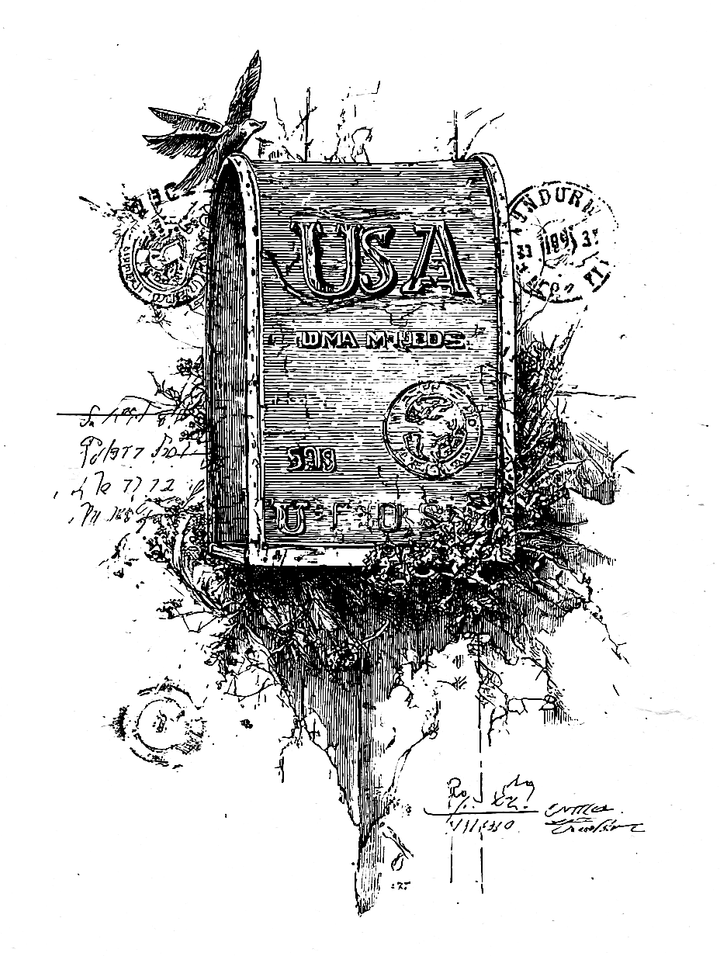
Image (device): USPS (AI-assisted digital image) by O:JA&L staff creative. 2025. Public domain via Midjourney AI.
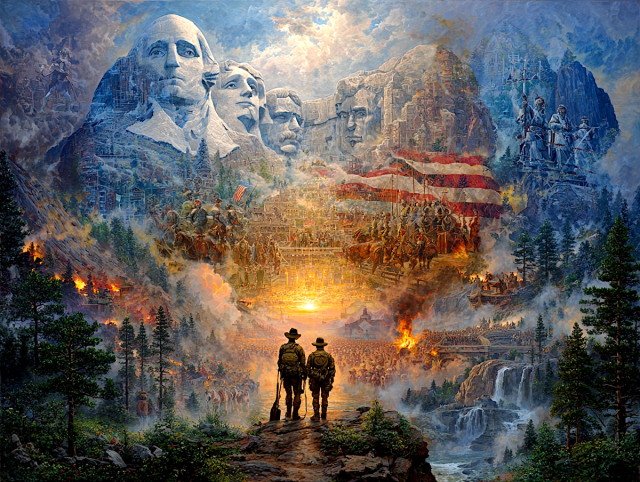
Featured Image: "Murica" (AI-assisted digital image) by O:JA&L staff creative. 2025. Public domain via Midjourney AI.
OJAL Art Incorporated, publishing since 2017 as OPEN: Journal of Arts & Letters (O:JA&L) and its imprints Buttonhook Press, HOT BUTTON PRESS Contemporary Issues, and HIGH BUTTON PRESS Contemporary Art, supports writers and artists worldwide.
O:JA&L’S BUTTONHOOK PRESS MASTERS SERIES
CLICK ON THE TITLES TO EXPLORE THE FREE PDF CHAPBOOKS IN THE MASTERS SERIES
The Buttonhook Press Masters Series: Brian Clements on Prose Poetry
With an Interview by Associate Editor Pamelyn Casto
The Buttonhook Press Masters Series: Mark Budman on Flash Discourse
With an Interview by Associate Editor Pamelyn Casto
The Buttonhook Press Masters Series: Ray Gonzalez on Prose Poetry
With an Interview by Associate Editor Pamelyn Casto
The Buttonhook Press Master Series: Michael Martone on Flash Fiction
With an Interview by Associate Editor Pamelyn Casto
The Buttonhook Press Master Series: Roberta Allen on Flash Fiction
With an Interview by Associate Editor Pamelyn Casto
The Buttonhook Press Master Series: Peter Conners on Flash Fiction
With an Interview by Associate Editor Pamelyn Casto
The Buttonhook Press Masters Series: Maxine Chernoff on Prose Poetry
With an Interview by Associate Editor Pamelyn Casto
MORE TITLES IN PRESS

- Americana
- creative writing
- essay
- fiction
- Jason Thornberry
- literary arts
- prose discourse
- Saint Rudy
- short fiction to 5000 words
- short story