 Submit
O:JA&L FREE PRESSES|HAL: Heuristic Analysis Library|O:JA&L Guides & Rubrics||The Poetic Encounter|A Glossary of Form & Practice

Jeff Streeby
October 26th, 2026


HAL: Heuristic Analysis Library
O:JA&L Guides & Rubrics
THE POETIC ENCOUNTER:
An O:JA&L Glossary of Form and Practice
Click on the title to explore or download the free PDF document.
Click HERE to explore the expanding catalog of titles at O:JA&L’s POETS’ RESOURCE COLLECTION.
THE POETIC ENCOUNTER: AN O:JA&L PERSPECTIVE
For Open: Journal of Arts & Letters (O:JA&L), poetry is both an art of concentrated language and a living field of inquiry. A poem may begin in private perception, public history, formal experiment, inherited tradition, or the pressure of contemporary life; whatever its point of origin, it enters a larger conversation among writers, readers, artists, cultures, and disciplines. This document offers a practical framework for participating in that conversation.
The definition that follows emphasizes poetry’s interdependent features: concentration, deliberate diction, sound and rhythm, imagery and figurative language, form, voice and perspective, and emotional and imaginative effect. These categories are not rules for deciding whether a work “counts” as poetry. Rather, they are lenses for noticing what a poem does—how it shapes attention, organizes language, creates relationships among sound and sense, and makes experience available for renewed perception. Individual poems may foreground some features, resist others, or invent alternatives.
This approach accords with O:JA&L’s interest in work that is formally alert, intellectually engaged, and open to encounters across aesthetic and cultural boundaries. It recognizes the poem as at once crafted object, performed utterance, imaginative event, and site of interpretation. It also leaves room for hybrid and interdisciplinary practice: prose poetry, visual poetry, spoken word, translation, documentary work, and writing that converses with other arts all extend the possibilities of poetic form.
The associated glossary is therefore meant as a working vocabulary rather than a set of prescriptions. Its terms help poets describe craft choices, help readers articulate effects, and help critics connect close reading to broader questions of history, identity, ethics, and artistic practice. Because traditions vary and poetic language continues to change, the glossary cannot be absolutely final. It instead offers an expansive point of entry—one that supports attentive reading while remaining responsive to innovation, plurality, and the ongoing reinvention of poetry.
POETRY: AN O:JA&L DEFINITION
Poetry is the artful concentration of experience, thought, or emotion in language deliberately shaped for meaning, sound, rhythm, imagery, and form. It invites readers or listeners to experience words not only as statements, but also as patterns of sensation, association, and feeling. Although poems often use lines and stanzas, meter, or rhyme, none of these devices is universally required; poetry may also take free-verse or prose-poem forms.
ESSENTIAL FEATURES
- Concentration: Poetry compresses significance, making individual words, pauses, and arrangements carry unusual weight.
- Deliberate diction: Poets select words for denotation and connotation—their direct meanings and their emotional, cultural, and symbolic associations.
- Sound and rhythm: Stress, cadence, repetition, rhyme, alliteration, assonance, and silence create a heard or implied music. Regular meter is one option, not a requirement.
- Imagery and figurative language: Sensory detail, metaphor, simile, symbol, and related devices make abstractions perceptible and reveal connections beyond literal statement.
- Form: A poem organizes language through such elements as lines, line breaks, stanzas, syntax, spacing, or—in a prose poem—the patterned intensity of poetic language without verse lines. Form helps govern pace, emphasis, tone, and expectation.
- Voice and perspective: A poem presents a speaking presence or persona whose attitude, tone, and point of view shape the reader’s encounter with its subject.
- Emotional and imaginative effect: Poetry seeks not merely to report experience but to re-create, transform, or freshly disclose it, often allowing ambiguity and multiple interpretations.
IN BRIEF
Poetry is distinguished less by a single mandatory technique than by the heightened attention it gives to how language means and how language feels. Its essential features work together: compression intensifies diction; sound and rhythm animate it; imagery and figurative language enlarge it; form directs it; and voice turns it into an imaginative and emotional encounter.
AN O:JA&L GLOSSARY OF POETRY TERMS
The terms below provide broad coverage of the major vocabulary used to read, analyze, and discuss poetry, grouped according to the Essential Features identified above. Because poetic traditions continually evolve and include culture-specific forms worldwide, no finite glossary can contain every term; this glossary emphasizes widely established English-language analytical terms and major forms from diverse traditions. Some terms could fit more than one category; each appears where its primary function is clearest.
CONCENTRATION
Ambiguity: The capacity of a word, image, or passage to sustain more than one plausible meaning.
Aphorism: A concise statement expressing an observation, principle, or general truth.
Compression: The concentration of extensive meaning or feeling into relatively few words.
Ellipsis: The deliberate omission of words or connections that readers must infer.
Fragment: An intentionally incomplete utterance or text whose gaps contribute to its effect.
Implied meaning: Significance suggested by context, association, or structure rather than stated directly.
Juxtaposition: The placement of unlike or contrasting elements beside one another to produce comparison, tension, or a new implication.
Motif: A recurring image, phrase, idea, or situation that develops a poem’s meaning.
Paradox: An apparently self-contradictory statement that reveals a defensible insight.
Repetition: The recurrence of sounds, words, phrases, lines, or structures for emphasis and pattern.
Resonance: The accumulation of associations and echoes that gives an element significance beyond its immediate context.
Understatement: Deliberately restrained expression that presents something as less significant than it is.
Volta: A turn in thought, argument, mood, or perspective, especially associated with the sonnet.
DELIBERATE DICTION
Archaism: A word or construction retained from an earlier period of language.
Colloquialism: An informal expression characteristic of everyday speech.
Connotation: The emotional, cultural, or associative meanings a word carries beyond its dictionary definition.
Denotation: A word’s direct or dictionary meaning.
Dialect: A language variety associated with a region or social group, represented through vocabulary, grammar, or pronunciation.
Diction: A poet’s purposeful selection and arrangement of words, including their level of formality and historical or regional character.
Double entendre: An expression designed to carry two meanings, often one indirect or risqué.
Elision: The omission of a sound or syllable, often to preserve rhythm or meter.
Epigram: A brief, pointed, and often witty statement or poem.
Epithet: A descriptive word or phrase attached to a person or thing to emphasize a characteristic.
Hyperbole: Deliberate exaggeration used for emphasis or effect.
Idiom: A conventional expression whose meaning cannot be derived solely from its individual words.
Inversion: A reversal of ordinary word order, often for emphasis, rhyme, or meter.
Litotes: Understatement that affirms something by negating its opposite.
Neologism: A newly coined word or expression.
Parataxis: The placement of clauses or phrases beside one another without explicit markers of their relationship.
Pun: Wordplay exploiting similar sounds or multiple meanings.
Register: The variety or level of language associated with a particular audience, setting, profession, or social context.
Rhetorical question: A question posed for emphasis or reflection rather than to obtain an answer.
Semantic field: A group of words connected by a shared area of meaning.
Slang: Highly informal vocabulary associated with a group, activity, or period.
Syntax: The ordering of words and phrases in sentences; poets may alter ordinary syntax to control emphasis, rhythm, or ambiguity.
Wordplay: The exploitation of multiple meanings or sound similarities, as in puns, to create wit or layered significance.
SOUND AND RHYTHM
Accent: Prominence given to a syllable through stress, pitch, or duration.
Alliteration: The repetition of consonant sounds, especially at the beginnings of nearby words.
Anapest: A metrical foot of two unstressed syllables followed by one stressed syllable.
Assonance: The repetition of similar vowel sounds in nearby stressed syllables.
Cadence: The rhythmic rise and fall of language, whether or not it follows a fixed meter.
Caesura: A meaningful pause within a poetic line, often marked by punctuation or spacing.
Catalexis: The omission of an expected syllable at the end of a metrical line.
Consonance: The repetition of consonant sounds within or at the ends of nearby words.
Dactyl: A metrical foot of one stressed syllable followed by two unstressed syllables.
Dimeter: A line containing two metrical feet.
Dissonance: A harsh or clashing combination of sounds.
End rhyme: Rhyme occurring at the ends of poetic lines.
End-stopped line: A line that concludes with a grammatical pause or completed phrase.
Euphony: A pleasing or harmonious arrangement of sounds.
Feminine rhyme: Rhyme involving a stressed syllable followed by one or more unstressed syllables.
Foot: A basic unit of meter composed of a patterned combination of stressed and unstressed syllables.
Hexameter: A line containing six metrical feet.
Iamb: A metrical foot of one unstressed syllable followed by one stressed syllable.
Internal rhyme: Rhyme occurring within a line or between words inside separate lines.
Masculine rhyme: Rhyme on a final stressed syllable.
Meter: A recurring pattern of stressed and unstressed syllables organized into units called feet.
Monometer: A line containing one metrical foot.
Onomatopoeia: The use of a word whose sound imitates or evokes what it names.
Pentameter: A line containing five metrical feet.
Prosody: The study and practice of poetic rhythm, meter, stress, and sound.
Pyrrhic: A metrical foot conventionally described as two unstressed syllables.
Refrain: A line or phrase repeated at intervals in a poem.
Rhyme: The correspondence of sounds in words, commonly—but not exclusively—at line endings.
Rhyme scheme: The patterned arrangement of end rhymes, commonly represented by letters.
Rhythm: The movement created by patterns of stress, duration, phrasing, and pause.
Scansion: The analysis and marking of a poem’s metrical pattern.
Slant rhyme: An approximate rhyme using similar but not identical sounds.
Spondee: A metrical foot or substitution consisting of two stressed syllables.
Stress: Relative emphasis placed on a syllable in speech or verse.
Tetrameter: A line containing four metrical feet.
Trimeter: A line containing three metrical feet.
Trochee: A metrical foot of one stressed syllable followed by one unstressed syllable.
IMAGERY AND FIGURATIVE LANGUAGE
Allegory: A narrative or sustained representation whose characters and events carry a secondary moral, political, or spiritual meaning.
Allusion: An indirect reference to another text, person, event, myth, or cultural object.
Analogy: A comparison used to clarify a relationship or idea.
Anthropomorphism: The representation of a nonhuman being or object as possessing human form or behavior.
Archetype: A recurrent image, character, or pattern recognized across works or cultures.
Conceit: An extended, often surprising comparison that organizes a substantial part of a poem.
Figurative language: Language used beyond its literal sense to create comparison, association, emphasis, or imaginative transformation.
Imagery: Language that represents sensory experience—sight, sound, touch, taste, smell, or bodily sensation.
Metaphor: An implicit comparison in which one thing is understood in terms of another.
Metonymy: The substitution of a related term for the thing meant, such as “the crown” for monarchy.
Objective correlative: A set of objects, events, or circumstances used to evoke a particular emotion.
Oxymoron: The combination of apparently contradictory terms in a compact expression.
Pathetic fallacy: The attribution of human feelings to nature, weather, or inanimate surroundings.
Personification: The attribution of human characteristics to an animal, object, abstraction, or natural force.
Simile: An explicit comparison, usually introduced by “like,” “as,” or a similar expression.
Symbol: A concrete element that signifies itself while also suggesting further meanings.
Synecdoche: A figure in which a part represents a whole, a whole represents a part, or a related scope is substituted.
Synesthesia: Description of one sense in terms normally associated with another.
Tenor and vehicle: In metaphor, the subject being described and the image through which it is described.
Trope: A figurative turn or use of language, such as metaphor, irony, or metonymy.
FORM
Ballad: A narrative poem or song, often arranged in quatrains and shaped by repetition and traditional meter.
Blank verse: Unrhymed poetry written in a regular meter, most commonly iambic pentameter.
Canto: A major division of a long poem.
Closed form: Poetry following an established pattern of meter, rhyme, line count, or stanza arrangement.
Concrete poetry: Poetry whose visual arrangement contributes essentially to its meaning.
Couplet: A pair of consecutive lines functioning as a unit, whether rhymed or unrhymed.
Dramatic monologue: A poem in which a character speaks to a silent listener in circumstances that reveal the speaker’s character.
Elegy: A poem of mourning, remembrance, or sustained reflection on loss.
Enjambment: The continuation of a grammatical phrase or sentence beyond the end of a poetic line.
Epic: A long narrative poem concerning culturally significant actions, journeys, or heroic figures.
Fixed form: A poetic structure governed by established rules for such features as line count, meter, stanza pattern, or rhyme.
Free verse: Poetry without a regular meter or fixed rhyme scheme, shaped instead by variable rhythms, syntax, and lineation.
Ghazal: A form of autonomous couplets linked by a repeated word or phrase and rhyme, originating in Arabic and developed in Persian, Urdu, and other traditions.
Haibun: A Japanese form combining prose passages with haiku.
Haiku: A compact Japanese form traditionally attentive to season, perception, and a juxtaposed turn of awareness.
Line: A primary unit of poetic organization whose ending may reinforce, suspend, or complicate syntax and meaning.
Line break: The point at which one poetic line ends and another begins.
Lyric: A usually brief poem emphasizing a speaker’s perception, meditation, or emotion.
Narrative poem: A poem that tells a story through characters, events, and temporal development.
Ode: A lyric poem of address, praise, meditation, or sustained consideration.
Open form: Poetry whose structure is generated by the individual work rather than a predetermined scheme.
Ottava rima: An eight-line stanza in iambic pentameter, typically rhyming ABABABCC.
Pantoum: A repeating form of linked quatrains derived from the Malay pantun.
Prose poem: A poem presented in prose sentences and paragraphs while employing poetic compression, imagery, rhythm, and figurative language.
Quatrain: A stanza of four lines.
Sestina: A form of six six-line stanzas and an envoy, structured by the patterned repetition of six end-words.
Sonnet: A fourteen-line form with several established structural and rhyme traditions.
Stanza: A grouped set of lines functioning as a structural unit within a poem.
Stichic verse: Verse arranged as a continuous sequence of lines rather than divided into stanzas.
Tanka: A Japanese five-unit lyric form traditionally organized in a 5-7-5-7-7 sound pattern.
Tercet: A stanza or group of three lines.
Terza rima: Interlocking tercets commonly rhyming ABA BCB CDC and continuing.
Verse: Poetry generally, or one metrical line; context determines the meaning.
Villanelle: A nineteen-line fixed form using five tercets, a quatrain, two repeating refrains, and two rhymes.
Visual poetry: Poetry in which typography, spacing, or graphic arrangement is integral to interpretation.
VOICE AND PERSPECTIVE
Address: The orientation of a speaker’s words toward a particular listener, audience, object, or abstraction.
Apostrophe: A direct address to an absent person, an abstract quality, an inanimate object, or a nonhuman being.
Audience: The actual or imagined readers or listeners toward whom a poem is directed.
Dramatic situation: The implied circumstances surrounding a speaker, audience, setting, and utterance.
Invocation: A formal appeal for inspiration or assistance, often addressed to a muse or deity.
Monologue: An extended utterance by one speaker.
Oral poetry: Poetry composed, transmitted, or performed primarily through speech and memory.
Persona: A constructed identity or character through whom a poem speaks.
Poetic diction: A distinctive vocabulary or style conventionally associated with poetry or adopted by a particular poet.
Point of view: The position from which a poem presents experience, such as first, second, or third person.
Speaker: The voice that speaks in a poem, not necessarily identical with the poet.
Spoken word: Poetry composed primarily for live performance, emphasizing voice, rhythm, gesture, and audience engagement.
Subject: The person, object, event, or idea a poem considers.
Tone: The speaker’s implied attitude toward the subject, audience, or situation.
Unreliable speaker: A speaker whose statements or interpretations invite doubt because of limited knowledge, bias, or contradiction.
Voice: The distinctive speaking presence created through diction, syntax, rhythm, tone, and perspective.
EMOTIONAL AND IMAGINATIVE EFFECT
Atmosphere: The overall emotional quality created by a poem’s setting, imagery, sound, and diction.
Catharsis: The release or clarification of emotion associated with experiencing a work of art.
Defamiliarization: The presentation of familiar things in an unfamiliar way so they are perceived anew.
Didactic poetry: Poetry intended primarily to teach, instruct, or convey a moral or philosophical lesson.
Emotive language: Language chosen to arouse a particular feeling or judgment.
Epiphany: A sudden moment of insight, recognition, or revelation.
Intertextuality: The network of relationships through which a poem echoes, revises, or responds to other texts.
Irony: A tension between literal statement and intended meaning, appearance and reality, or expectation and outcome.
Mood: The feeling or emotional state a poem evokes in its reader.
Negative capability: The capacity to remain open to uncertainty, mystery, and doubt without forcing a single resolution.
Pathos: A quality that elicits pity, tenderness, sorrow, or sympathetic feeling.
Satire: The use of wit, irony, exaggeration, or ridicule to expose folly or vice.
Sublime: An aesthetic effect of grandeur, awe, terror, or power that exceeds ordinary comprehension.
Tension: A productive conflict among meanings, tones, images, rhythms, or formal pressures.
Theme: A poem’s developed insight into a subject rather than merely the subject itself.
Unity: The sense that a poem’s elements work together as an integrated whole.
ONLINE REFERENCES CONSULTED
- Encyclopaedia Britannica, “Poetry” and “Poetry Summary.”
- Academy of American Poets, “Glossary of Poetic Terms,” “Poetry Glossary,” “Form,” and individual glossary entries.
- Poetry Foundation, “Glossary of Poetic Terms” and “Prose Poem.”
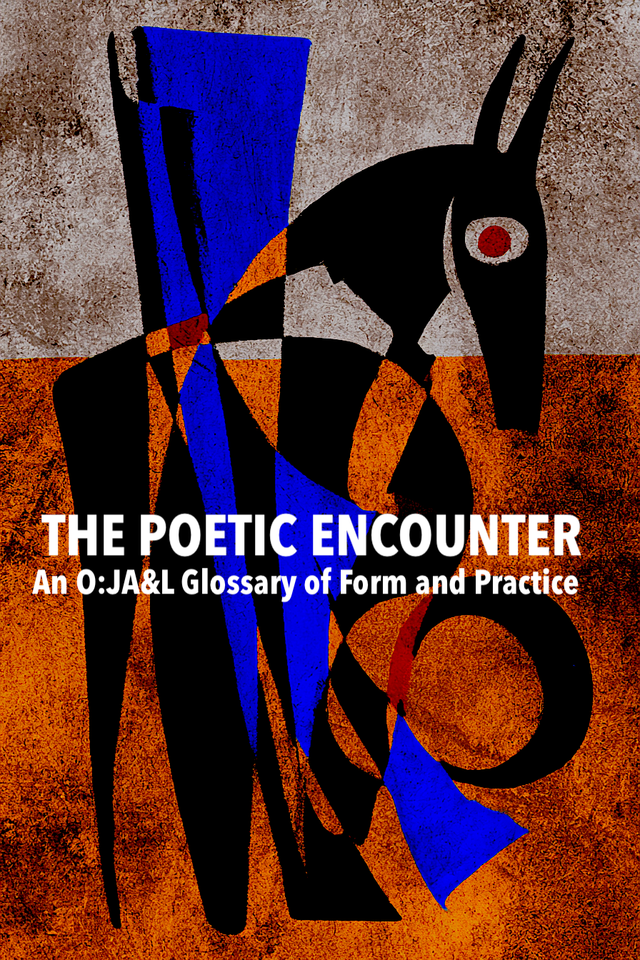
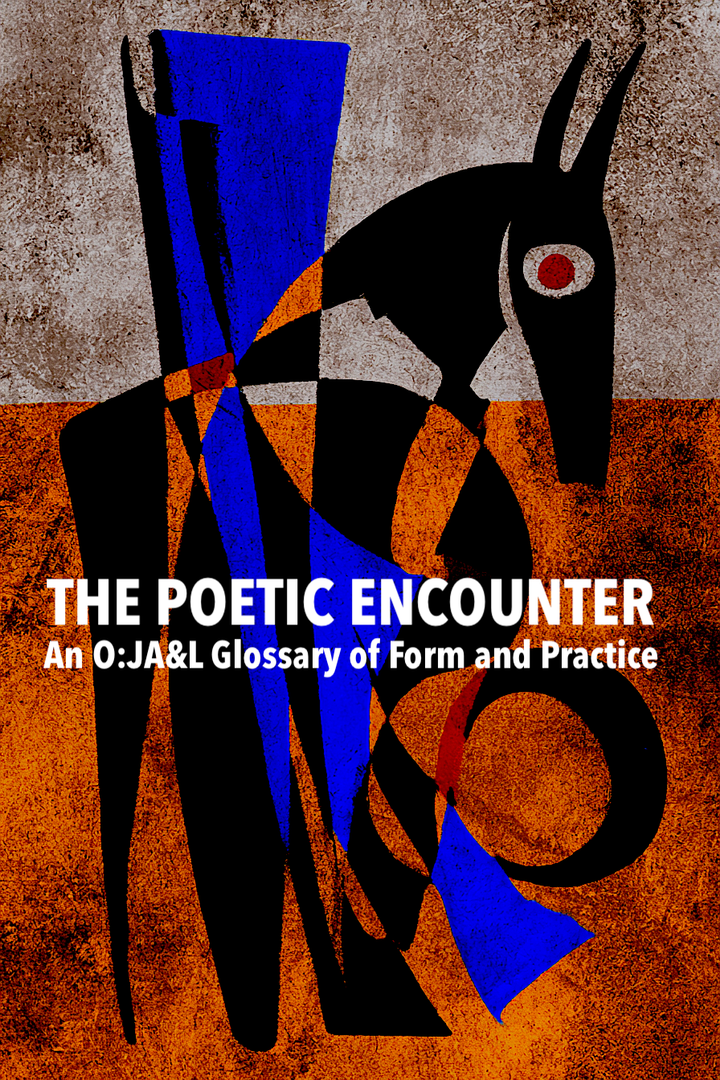
Cover Image: Pegasus at the Spring (SI-assisted digital image) by O:JA&L staff creative. 2026. Public domain via Midjourney AI.
OJAL Art Incorporated, publishing since 2017 as OPEN: Journal of Arts & Letters (O:JA&L) and its imprints Buttonhook Press, HOT BUTTON PRESS Contemporary Issues, and HIGH BUTTON PRESS Contemporary Art, supports writers and artists worldwide.
O:JA&L’S FREE PRESSES
CLICK ON THE IMPRINT TITLES TO EXPLORE THE OFFERINGS
Buttonhook Press
HOT BUTTON PRESS: Contemporary Controversies
HIGH BUTTON PRESS: Contemporary Art
FIREFIGHT PRESS: Trench Arts & Letters
DALLY POST PRESS: Cowboy Poetry
QUARTOS & QUIRES: Writing for Page, Stage & Screen
HAL: Heuristic Analysis Library
- poetic rhythm
- poetry reference guide
- poetry writing guide
- haiku definition
- sonnet definition
- free verse
- fixed verse forms
- stanza forms
- poetry perspective
- poetic voice
- poetry diction
- poetry imagery
- sound devices
- prose poetry
- rhyme scheme
- poetry meter
- figurative language
- poetic devices
- poetry analysis
- poetry definitions
- literary terms
- poetry forms
- poetic terms
- poetry glossary
- spoken word poetry